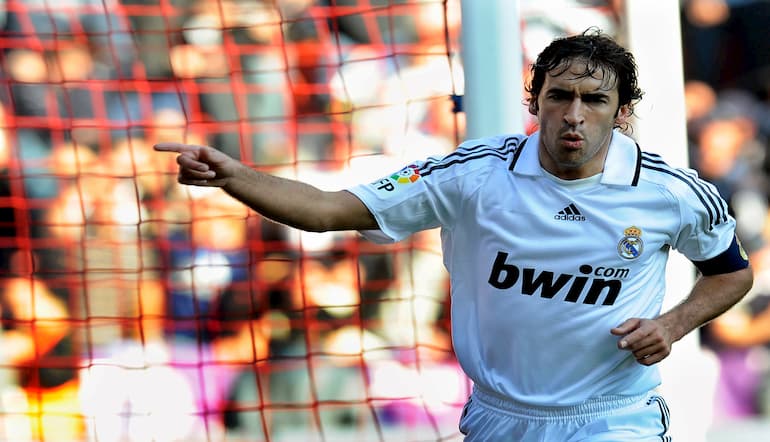
1. Adebayo Akinfenwa

One of the most powerful men in football, Akinfenwa would suit the prop position down to the ground. Strength is crucial for any prop and the Wycombe Wanderers striker is the ideal player to lead the forward unit.


2. Fabio Cannavaro

Cannavaro ticks all the right boxes to succeed as the team’s hooker. His leadership skills would be handy, particularly at line-outs and when controlling a rolling maul. One of the most committed men in sport, the Italy legend makes the cut.


3. Wes Morgan

Not afraid to throw his weight around, Morgan is the perfect tighthead prop. Like with Akinfenwa, he is exceptionally strong and won’t take any nonsense in and around the ruck. He doesn’t score often but when he does, it’s always a special moment.


4. Peter Crouch

Crouchy would make a good lock. His huge frame would help him to get over the gain line and would give the team a major advantage at line-outs. Meanwhile, his influence in the changing room would help keep morale high… literally.


5. Jaap Stam

As Crouch’s partner at five, you don’t get much better than Stam. A natural leader, the Dutchman would give the team a reliable pair of hands and his impact at the scrum and at the breakdown would be clear for all to see.

Jaap Stam
Photo credit: Fernando Llano / AP Photo


6. Roy Keane

Keane is a number six to a tee. On the football pitch, he made a name for himself for his drive and determination in midfield and he would be the perfect blindside flanker. Winning the ball back is Keane’s speciality while he could also contribute with the occasional try.


7. Vinnie Jones

Another battle axe at seven, Jones was part of Wimbledon’s crazy gang in the 1980s. On the rugby pitch, Jones would be one of those players you try to avoid – discipline may be a bit of an issue but he would strike the fear of God in opposing players.


8. Duncan Ferguson

The Everton legend was nicknamed ‘Big Dunc’ for a reason. Similar to ‘Big Billy’ Vunipola, Ferguson could take on the 8 role. Although much slender than Vunipola, he would be tough to bring down once he got motoring and he can put the team on the front foot.


9. Dennis Wise

The perfect choice for scrum half. Wise loves to get involved and the number nine touches the ball more than any other player on the pitch. He doesn’t mind getting down and dirty but can also spark an attack – doesn’t get as much recognition as other back positions.


10. Andrea Pirlo

The playmaker. Your number 10 needs to control the game and who is better at that than Pirlo? Although often playing in second gear, Pirlo’s accuracy with the boot would suit the fly-half role and his place kicking would prove beneficial to the team.

Andrea Pirlo
Photo credit: Matt Dunham / AP Photo


11. Cristiano Ronaldo

One of the best finishers of all-time, Ronaldo is an absolute must. He has the physique, he has the speed and he has the nous to shine as a rugby winger. Defensively, he may fall a little short but his attacking threat is so great that he cannot be dropped.


12. Paul Scholes

Scholes can take on the Owen Farrell role. Playing at centre, Scholes would be heavily involved in build-up play while he will also score plenty of tries. Not afraid to get stuck in, he has one of the most important roles on the team and that will only maximise his impact.


13. Zinedine Zidane

Alongside Scholes, we have Zidane. A slightly bigger option at 13, Zidane’s creativity and unselfish attitude are his best traits. One of the most skilful players on the team, he can offload in the tightest spaces in order to benefit his teammates.


14. Adama Traore

A speed demon. Like Ronaldo, Traore is the ideal candidate to feature on the wing – mainly due to his incredible burst of speed. A strong kicking game from Pirlo and Scholes would be beneficial from Traore and he could be used in a similar way to England’s Jonny May.


15. Steven Gerrard

Reliable, controlled and a leader – three traits needed to be a full back and Gerrard ticks all of the boxes. Capable of turning defence into attack in a split second, Gerrard is the ideal full back and he is one of the most consistent players on the team.


Replacements:

16. Marco Matterazzi

17. Virgil van Dijk

18. Neil Ruddock

19. Zlatan Ibrahimovic

20. Romelu Lukaku

21. Lionel Messi

22. Raheem Sterling

September 26, 2019

By Alex McMahon

Alex McMahon Sport
Body

Alex is a sports betting tipster, specialising in Premier League football, the Champions League and horse racing.

He loves placing a weekly accumulator on the football at the weekend and dreams of landing the big winner that will take him back to Las Vegas.

As well as writing sports betting tips for 888sport since 2015, Alex has produced content for several international media companies, such as Goal.com and The SPORTBible. 
 

Alex McMahon
factcheck
Off
hidemainimage
show
Hide sidebar
show
Fullwidth Page
Off
News Article
Off

Andy Murray’s return to the court at Wimbledon earlier this year attracted the attention of the tennis world.

Partnered with Serena Williams, Murray was part of one of the most well-supported doubles teams in Wimbledon history. Whether the Scot will return to the top of the singles’ game remains to be seen, however.

Despite occupying the world number one spot in 2016, playing in 11 Grand Slam finals and winning two Olympic gold medals, Murray’s legacy is unclear.

In the unenviable position of sharing an era with the big three, Murray was the fourth member of that group. Late-career injuries and a total of three Grand Slam victories put Murray a level, maybe several, below the big three.

He isn’t among the best players to win Wimbledon, yet his direct competition with Roger Federer, Rafael Nadal and Novak Djokovic poses a question: How good would Murray have been in another era?

At his peak between 2011 and 2016, Murray was an undoubted superstar. It was a ‘big four’ through that period, and Murray was comfortably better than the rest of the field.

Consistently making it into the quarter-finals and beyond, he had the ability to beat each of Federer, Nadal and Djokovic, but doing so consistently was a step too far.

Djokovic has dominated Murray throughout their senior careers, winning 25 of 36 matches. Nadal has won more than he’s lost against Murray on all three surfaces. Despite having the best of Federer in the earlier years, the Swiss great has a favourable record, too.

It’s obviously not as simple as handing Murray the trophy from all the finals he lost to the big three. He benefited in some ways from playing against three of the greatest ever, and it’s unfair to assume he could have played in an era without a dominant force.

The standard Murray was at in the early part of this decade, though, was extraordinarily high, and he was a bit of luck away from winning five, six, seven or eight Slams.

Catching one of the big three on a rare off-day, maybe when they’re struggling with a cold or an injury, and Murray could have easily doubled (or more) his Grand Slam tally.

These are all hypotheticals, of course, but they aren’t unreasonable suggestions. Murray was miles ahead of the pack, he just suffered at the hands of Djokovic and Federer, in particular.

Say Murray scraps his way to a couple of Australian Open titles and gets the better of Djokovic at Roland Garros in 2016. Boris Becker and Stefan Edberg won six Slams – Murray would be at that level. He would have achieved a career Grand Slam.

This might seem like some sort of peculiar fantasy land, but there’s a point to this. Murray’s legacy, as it stands, is relatively unspectacular. On paper, his record is good, not great.

His catalogue of finals losses looks like a player who crumbled under pressure (which was a fairer criticism in his early years). A total of 41 weeks at world number isn’t ‘all-time great’ stuff.

Those who followed his career throughout know that Murray was so much more than his numbers tell you.

His role in a golden era of men’s tennis wasn’t that of an opportunist when the big three were hurt, he was every bit their rival, even if he didn’t get the better of them as often as he would have liked.

Andy Murray Wimbledon
Photo credit: Kirsty Wigglesworth / AP Photo


For a prolonged period, the rest of the men’s draw were as fearful of facing Murray as they were Djokovic, Federer or Nadal – he was that good.

While the big three are competing to finish with the most Grand Slam titles, Murray’s place in the history books is subtler.

He isn’t anywhere to be seen on such lists, he didn’t win in Melbourne or Paris, but for a not-insignificant spell, he was every bit as massive in men’s tennis.

Fortunately the 2012 US Open and, to a greater extent perhaps, the 2013 Wimbledon crown, made sure Murray wasn’t always going to be the bridesmaid. From a young age it was clear he had the ability to be a Grand Slam champion, and he did so on three occasions.

It could have been so much more with a bit more fortune or a career that started a few years later, but that shouldn’t diminish the level he was at during those brilliant peak years.

When it came to tennis betting strategy, Murray was a player who evolved through his career. His work ethic was well-publicised, as he went from lanky teenager to supreme athlete, capable of going toe-to-toe with anyone over five sets.

The tale of that development can be told in Grand Slam finals – the player who lost to Federer in New York in 2008 was almost unrecognisable from the ruthless world’s best that swept Milos Raonic aside on Centre Court in 2016.

It’s easy to focus on what Murray wasn’t (the best player of his generation, an all-time great), but that does a disservice to a wonderful career at the top of the men’s game. Who knows, it might not be over just yet…


Secure a smash on the most up to date tennis markets with 888 Sport


*Credit for the main photo belongs to Kirsty Wigglesworth / AP Photo*

September 25, 2019
Body

Sam is a sports tipster, specialising in the Premier League and Champions League.

He covers most sports, including cricket and Formula One. Sam particularly enjoys those on the other side of the Atlantic Ocean – notably MLB and NBA.

Watching, writing and talking about sports betting takes up most of his time, whether that is for a day out at T20 Finals Day or a long night of basketball.

Having been writing for several years, Sam has been working with 888Sport since 2016, contributing multiple articles per week to the blog.

Sam Cox
factcheck
Off
hidemainimage
show
Hide sidebar
show
Fullwidth Page
Off
News Article
Off

Not many sports are as plentiful as tennis when it comes to betting. The season lasts pretty much all the way through the calendar year, with matches taking place all over the planet.

From Davis Cups to Grand Slams and the even the Olympics, tennis is ever-present, Melbourne, Paris, London and New York might get the majority of the attention, but it’s a rare day that there’s no tennis taking place.

888sport’s tennis odds are an example of this. Whether played in Dubai or Nottingham, the opportunity to make money betting on tennis is there. To avoid misjudged bets, here are a few tips on picking the perfect tennis wager…


Head-To-Heads Can Be Misleading

Tennis loves looking at the ‘last time they met’ and career records. While there’s some worth in that, it often isn’t as significant as the odds would have you believe.

The best ever players might not be as impacted by this as some others, but we will still see it alter odds for Roger Federer, Novak Djokovic and Rafael Nadal if they have slipped up against an opponent on multiple occasions.

Sure, if someone is 5-0 against Federer, that’s worth something, but unless you’ve looked into each of those matches, it’s probably not as meaningful as the odds show.


Question The Norms

There are certain beliefs, and perhaps even clichés, that exist in tennis betting that aren’t as watertight as people may think.

A player coming back from a set or two down doesn’t guarantee a victory in the decider, in fact that pattern is all too often overplayed. This can lead to great value on the player that has just lost a set.

Just because everyone else is following a way of thinking, it doesn’t mean it’s the right way to go. In tennis betting, it often leaves openings to take advantage of going against the flow.

Analyse & Research Form

The betting markets will shift when they sense a player has hit bad form. It’s always worth considering the cause of form, however, rather than taking the results at face value and missing a trick.

If a player cruised to a tournament victory last week, but they faced a lot of inferior or partially injured opponents, it’s worth taking it with a pinch of salt.

If someone suffered a shock heavy defeat, a bit of extra reading could reveal a legitimate excuse. Depending on the reason, that could see them given a great price for their next outing.

Markets can be too sensitive to perceived form without proper consideration. The same goes for results at a tournament – does it really matter that a player lost at Queen’s in the first round three years in a row if they have played brilliant tennis over the last two months?


Keep Eyes Peeled Pre-Match

Rumours can see odds drift pre-match. It can be about an injury concern, or perhaps a wave of people wondering if the player is really motivated for the match.

Nadal is arguably the greatest player ever, but if he’s not really engaged, the chances of victory at very different. If he’s only playing at 70% because of a niggling injury, the underdog suddenly becomes a good betting option.

While these can be traps, it’s also worth keeping an open mind as the match approaches.


How Do They Fare In Big Moments?

Winning the big points, thriving in deciding sets, isn’t about luck. It’s often – like a penalty shootout – a mentality thing. Some athletes are at their best when it matters most, while others have a tendency to crumble.

Some have that golden combination of superhuman fitness and grit that makes them a threat even if they are two sets and a break down in a Grand Slam semi-final.

When it comes to in-play betting, all of these things are important. Know not just your player’s results, but know them, and know their record in certain situations.

Rafael Nadal and Roger Federer
Photo credit: Ben Curtis / AP Photo


Fan Favourite Fun

Not every bettor picks their bets logically. Plenty of people back someone emotionally. It can be about an underdog story, or a desire for that all-time great to win one more title. Whatever the reason, the outcome is the same: brilliant odds.

A wave of money on a universally loved figure like Roger Federer will see his price drop, and often leave his opponent at great value. Particularly when Grand Slams come around, these are bets to keep in mind, as the prices can become almost too good to be true.


Speedy Streams

If you’re not at the event, this is a tricky one. Streams from Sky Sports, BT and Eurosport are a lot slower than the ones used by bookmakers. Those extra few seconds can make all the difference for in-play trading.

Unless you’re going to be sat inches away from Djokovic on Centre Court, your best option is a ludicrously expensive stream. It can’t keep up with the guys in the arena, but it’s as close as you’re going to get.


Serve yourself some up to date tennis trivia on 888sport


*Credit for the main photo belongs to Adam Hunger / AP Photo*

September 25, 2019
Body

Sam is a sports tipster, specialising in the Premier League and Champions League.

He covers most sports, including cricket and Formula One. Sam particularly enjoys those on the other side of the Atlantic Ocean – notably MLB and NBA.

Watching, writing and talking about sports betting takes up most of his time, whether that is for a day out at T20 Finals Day or a long night of basketball.

Having been writing for several years, Sam has been working with 888Sport since 2016, contributing multiple articles per week to the blog.

Sam Cox
factcheck
Off
hidemainimage
show
Hide sidebar
show
Fullwidth Page
Off
News Article
Off