First ran in 2005, the Ryanair Chase is now one of the most eagerly anticipated races at the Cheltenham Festival.
This is the ultimate test for middle distance chasers, with 17 fences to be jumped on the New Course at Prestbury Park. It is the ultimate test of speed, stamina and desire.
While the Queen Mother Champion Chase and Cheltenham Gold Cup are more prestigious, the Ryanair Chase offers connections a chance to claim Grade One glory at the Cheltenham Festival.
Without further ado, let’s take a look at some of the most important Ryanair Chase trends and statistics.
Ryanair Chase Trends & Statistics
There are plenty of betting trends to follow for the Ryanair Chase – here are the key trends ahead of the 2020 Cheltenham Festival:
All 15 had started one or two races in the 90 days prior to Cheltenham.
15 out of 15 had won with same jockey onboard.
15/15 had at least two starts with the same jockey onboard.
14 of the 15s last win came at an English racecourse.
14 of the 15 winners ran in a field of six or more runners last time out.
14/15 had raced at least three times in Class 1 company.
14 out of 15 had previously raced at least two times at Cheltenham.
13/15 winners had made between two and four starts that season.
13 of the 15 winners had previously won over two miles five furlongs.
Top Trainers For The Ryanair Chase
Paul Nicholls is the most successful trainer in this race with three victories, most recently with Frodon at the 2019 Cheltenham Festival.
He will be back to defend his crown in 2020 and regular partner Bryony Frost will be jockeyed up for the second year in a row – could we see an emotional repeat at Prestbury Park?
Nicky Henderson and Willie Mullins have two wins apiece in this race and both trainers will have a couple of market principles for the 2020 Ryanair Chase.
Min has had to settle for second best in the two-mile chasing division behind Altior over the years but could be the one to watch as he steps up in trip.
Ryanair Chase Prize Money
There was a total prize fund of £350,000 up for grabs in the 2019 Ryanair Chase, making it one of the most lucrative races at the Cheltenham Festival.
With so much at stake, the best mid-distance chasers are likely to go to war at Prestbury Park – the Ryanair Chase could be one of the races of the week.
*Credit for the photo in this article belongs to Alamy*
Steven is a sports and horse racing enthusiast and is a member of the Horseracing Writers and Photographers Association (HWPA) in the United Kingdom.
He is a regular visitor to Paris Longchamp for the Prix de l'Arc de Triomphe and a lifelong fan of the Aintree Grand National, a subject he writes about 52 weeks of the year. Last year he reached the impressive milestone of attending the last 30 renewals of the Grand National.
Steven graduated from the University Of Lancaster in 1996 with a B.A (Hons) in Urban Policy & Race Relations (major) with Contemporary Religions & Belief Systems (minor) and still wonders if any of these help him find the winners?
He writes for a number of websites and online publications and you can sometimes hear him at the weekend discussing racing on a number of local radio stations.
Climbing the all-time All-Star appearance list requires elite talent and longevity.
Only the best in a given season get selected to the All-Star game and maintaining that over the best part of two decades is an achievement reserved for inner-circle Hall of Famers.
Of course, there are a few sentimental selections along the way, too. The list below shows the players with the most NBA All-Star appearances, featuring several players with a claim as the greatest to ever do it.
Kareem Abdul-Jabbar - 19
Despite having the most All-Star appearances ever, six rings and being the NBA’s all-time top scorer, Kareem Abdul-Jabbar’s place in the best NBA team is still up for debate.
Some would put Wilt Chamberlain, Shaquille O’Neal or Tim Duncan ahead of the six-time MVP. Kareem’s skyhook is as close to unstoppable as anything the NBA has seen.
Kobe Bryant – 18
The late Kobe Bryant ended his career one short of his fellow Lakers icon. Black Mamba was the youngest All-Star starter in league history in 1998.
Despite missing out in 1999, he was back on the roster in 2000 and was selected to every All-Star game from then on until his retirement.
Bryant picked up three rings alongside O’Neal at the start of the century and went back-to-back with Pau Gasol later in the decade.
LeBron James – 16
LeBron James remains among the best players in the NBA. His 16th All-Star selection in 2020 will not be his last, and he could be top of the pile by the time he calls it a day.
James’ career started in high school. Touted for superstardom from a young age, he has delivered throughout, winning in Miami and returning to Cleveland to deliver a title for the Cavaliers with the biggest comeback in NBA Finals history.
He’s now looking to lead the Lakers to their first chip in 10 years.
Shaquille O’Neal – 15
Shaquille O’Neal might be the most dominant player the league has seen. One can’t help but wonder what the league would’ve looked like if he and Kobe Bryant had stuck together.
As it was, O’Neal retired as a four-time champion with three Finals MVPs. He’s fourth all-time in career PER, behind LeBron James, Michael Jordan and Anthony Davis.
Kevin Garnett – 15
The best player in Minnesota Timberwolves history, and by quite a distance, Kevin Garnett collected the majority of his All-Star appearances while on the T-Wolves before the blockbuster trade that saw him join Paul Pierce in Boston.
Garnett won the 2008 championship with the Celtics – he finished his career with nine All-NBA selections on top of the 15 All-Star nods.
Tim Duncan – 15
A pillar of consistency, Tim Duncan won five titles across a decorated career that included 15 All-Star selections.
Duncan, known as ‘The Big Fundamental’, was the foundation of one of the greatest NBA dynasties in San Antonio, and a playoff streak that remains active.
Only six players in NBA history registered more win shares than Duncan. Four of them are on this list.
Michael Jordan – 14
His Airness would be a bit higher on this list if he hadn’t taken a mid-career break to try his hand at baseball.
Michael Jordan transcended basketball, taking the sport to new audiences. He has become an immensely successful businessman and the Jordan brand is one of the most recognisable around.
With five MVPs, six rings and six Finals MVPs, the 14 All-Star appearances are overshadowed on any list of Jordan’s achievements. That says it all.
Karl Malone – 14
The second-highest point scorer in NBA history, Karl Malone has everything but a ring on his CV. He has the joint-second most All-NBA first team selections alongside two pretty big names: Kobe Bryant and LeBron James.
The Mailman’s place in NBA history is a point of relative controversy, but there’s no doubt he’s one of the greatest power forwards to play the game.
Dirk Nowitzki – 14
Dirk Nowitzki’s 14th and final All-Star appearance came in 2019 as a gesture to his and Dwyane Wade’s retirements.
Nowitzki is the greatest European player in the history of the NBA and has 12 All-NBA selections on top of his 14 All-Star picks.
Like so many players on this list, Nowitzki’s trademark move will forever be associated with his game and what he brought to the Dallas Mavericks.
Jerry West – 14
A long-time Laker, The Logo was an All-Star regular during the 1960s and early 70s. Jerry West was a champion in 1972 alongside Wilt Chamberlain and he famously picked up Finals MVP in 1969 despite being on the losing side.
West went on to coach the Lakers and become general manager of the Memphis Grizzlies.
In recent years he has been an advisor for the Golden State Warriors and Los Angeles Clippers and remains one of the most respected voices in the league.
*Credit for the main photo belongs to George Brich / AP Photo*
Sam is a sports tipster, specialising in the Premier League and Champions League.
He covers most sports, including cricket and Formula One. Sam particularly enjoys those on the other side of the Atlantic Ocean – notably MLB and NBA.
Watching, writing and talking about sports betting takes up most of his time, whether that is for a day out at T20 Finals Day or a long night of basketball.
Having been writing for several years, Sam has been working with 888Sport since 2016, contributing multiple articles per week to the blog.
The NBA dunk contest is a display of the world’s greatest athletes performing inventive, and sometimes barely believable, slams. Scored by a panel in the arena, the dunk contest is arguably the headline event of NBA All-Star Weekend.
The Milwaukee Bucks’ Pat Connaughton, Orlando Magic’s Aaron Gordon, Miami Heat’s Derrick Jones Jr. and Los Angeles Lakers veteran Dwight Howard will compete in the 2020 edition of the dunk contest in Chicago.
Howard is a former winner and Gordon has entered before (more about that later).
The Thunder’s Hamidou Diallo became dunk champion in 2019 with a leap over Shaquille O’Neal.
John Collins paid tribute to the Wright Brothers in the first round, and Miles Bridges perfected a 360 with a Larry Johnson Hornets jersey on. Dennis Smith Jr. advanced to the final with a jump over J.Cole, but he fell short against Diallo in the final.
Will any of this year’s contestants write their place in dunk contest history? Here are five of the greatest ever dunk contest performances…
Julius Erving (1976)
It was the first ever dunk contest in 1976, and perhaps the most famous dunker in NBA history made his mark. The format was different, taking place at half-time in the ABA All-Star game and with restrictions.
Erving had to attempt one from a standing position and one from ten feet away from the cup before being allowed three freestyle attempts.
These all had to be completed within two minutes. Erving went last, following George Gervin, Larry Kenon, Artis Gilmore and David Thompson.
Dr J charged from one end of the court to the other, ball gripped firmly in his right hand. Taking off from the free-throw line, Erving erupted into the McNichols Sports Arena air and delivered an emphatic slam.
The dunk contest wouldn’t have been what it is today without Erving’s showstopper in Colorado.
Vince Carter (2000)
A showdown between Vince Carter, his cousin Tracy McGrady and Steve Francis puts the 2000 dunk contest among the greatest in history. Carter was the eventual winner, and widely considered the best participant ever.
The event was littered with show-stoppers, and Carter delivered several of them. A brace of 360-windmills and a honey dip were special, but it’s the between-the-legs dunk off a bounce pass from his cousin that stands out.
The commentary was perfect. Carter’s celebration is iconic and the reaction of one of the best arenas in basketball was fitting of the moment.
Despite appeals from sections of the NBA media, Carter will not be appearing at the 2020 dunk contest in Chicago.
Aaron Gordon (2016)
A point of dunk contest controversy, plenty of NBA fans would tell you Aaron Gordon should have won in 2016. It might have been the best dunk of competition, but he did it early in the event and it perhaps counted against him.
Mascots have been used in contests over the years. Gordon produced the best of all by jumping legs-first over Stuff the Magic Dragon.
He grabbed the ball from the mascot as he passed, transferring to his left hand for an earth-shattering windmill slam.
The most stunning dunk in contest history, perhaps. Gordon was unfortunate to finish second, but he’s heavily favoured to make up for that in 2020.
Zach LaVine (2016)
Only six players have won the dunk contest two or more times. Chicago’s Zach LaVine is one of them.
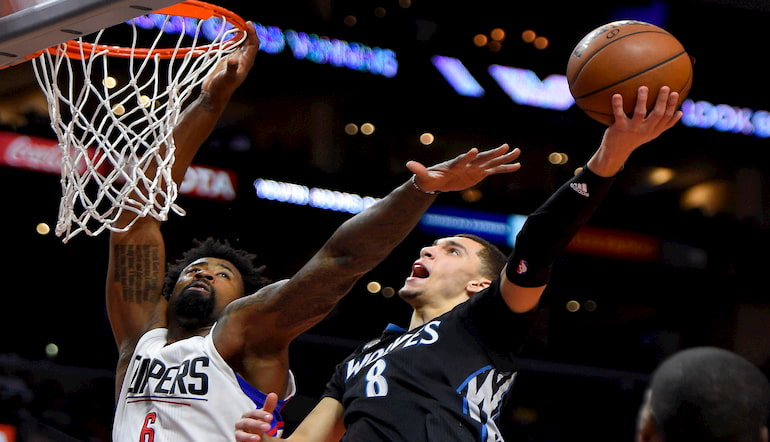
It was in a Timberwolves uniform that LaVine won the dunk contest, however, lifting the trophy in 2015 and 2016. The latter of his triumphs came following an incredible head-to-head with Aaron Gordon.
Photo credit: Mark J. Terrill / AP Photo
Pressured by some outrageous stuff from Gordon, LaVine had to produce his highest level of athleticism to execute a magnificent dunk for a perfect 50 and a second dunk contest crown.
With shades of Erving and Jordan, LaVine took off from the other end of the floor, exploding from the free-throw line and putting the ball between his leg, unleashing an effortless slam.
LaVine made it look so easy. His dunk contest days may be behind him, but the Bulls guard is one of the most thrilling dunkers in the NBA.
Michael Jordan (1987)
The 1987 dunk contest saw Michael Jordan pick up the first of two titles, with the second coming a year later.
Jordan’s hangtime and ability to pull off outrageous dunks is well known. While his 1987 performance didn’t quite match the game winner in Space Jam, it places among the best.
Jordan registered a 50 with his kiss-the-rim dunk in 1987. Curving his approach along the baseline, he took off into the atmosphere, apparently levitating around the rim as he adjusted his body shape and double clutched.
His head was right at the cup by the time he threw it down. It didn’t have assistance or props like others. It was pure athleticism and technique from His Airness.
*Credit for the main photo belongs to Gerald Herbert / AP Photo*
Sam is a sports tipster, specialising in the Premier League and Champions League.
He covers most sports, including cricket and Formula One. Sam particularly enjoys those on the other side of the Atlantic Ocean – notably MLB and NBA.
Watching, writing and talking about sports betting takes up most of his time, whether that is for a day out at T20 Finals Day or a long night of basketball.
Having been writing for several years, Sam has been working with 888Sport since 2016, contributing multiple articles per week to the blog.
The mention of ‘expected goals’ can start arguments on social media. The phrase ‘there’s only one stat that counts’ is heard semi-frequently on television coverage of the Premier League. Numbers in football are, in their own way, controversial.
Data is an enormous part of the modern game, though. Signings, tactics and even in-game decisions are guided, if not dictated, by data.
The use of data – or lack of – has become a differentiating factor between clubs.
Liverpool, for instance, have embraced data – the FSG ownership group did so with the Boston Red Sox following the Moneyball Oakland Athletics at the start of the 21st century.
The same approach has been used in football – it is the bedrock of Liverpool’s transition from upper-mid-table sleeping giant to the best club team in the world.
Sporting director Michael Edwards is a former analyst at Portsmouth and Tottenham. Edwards is regarded as the mastermind of Liverpool’s squad construction.
He hasn’t done it alone, however, as FSG have led a marked evolution of the staff on Merseyside. Ian Graham leads the research division and an astrophysicist and philosopher are involved in the data science team.
None of this takes away from the accomplishments of Jurgen Klopp and his coaching staff, but Liverpool are as good an example as any of data use in professional football.
They aren’t the only ones, of course, though their resurgence is the most high-profile example of its impact.
Teams and franchises are always looking for a marginal advantage in elite sport. Well-used data, and an extensive team of analysts can put a team more than a nose in front.
The contrast between Liverpool’s use of their resources and some of their supposed peers is stark, and should be alarming for their respective hierarchies.
Signings
Perhaps the most obvious application of data, the way a squad is built goes a long way to determining a team’s ceiling.
Recruitment has been a major part of professional football for decades, but with such riches at the top clubs now, finding an under-priced gem is more valuable than ever.
Matthew Benham, owner of Brentford, is a great example of how data can alter the ceiling of a club. Brentford’s revenue should lock them into League One. Instead, the west London outfit have flirted with promotion to the Premier League in recent seasons.
The Bees identify talent using data and focus on recruiting from undervalued leagues and nations. This brought Benham success at FC Midtjylland, and the same approaches have been used to recruit at Griffin Park.
Brentford are comfortable selling players when they believe they’re getting above market value, and this has helped the club sustain their place in the upper echelons of the Championship.
Neal Maupay and Chris Mepham are just two examples of the players they have made vast profit on. Clubs will use data in player recruitment to different extents.
Liverpool’s current squad was data-led and can be a way of finding players to fit a specific role in a team that others may not consider that player to be an option for. It can identify skills that conventional football statistics do not.
Tactics
Liverpool’s tactics have equally been influenced by data. It’s a natural progression, of course. Getting players at a good value isn’t worth much if they aren’t then used properly.
The concept of ‘pitch control’ has been invaluable to Liverpool and can be seen in many of their patterns of play. Liverpool’s full-back to full-back passes are a trademark of their game under Klopp. Defensively, the influence is clear, too.
Controlling the centre of the pitch is important. The best shots are created from in line with the goal. Liverpool are willing to give their opponents the flanks at times, and squeeze in the middle, forming a compact central block.
There’s no space between the lines for opponents to expose – it forces them to either go backwards or wide.
Pitch control uses tracking data to discover the impact of each action on the probability of a goal being scored. The key is making sure that Liverpool ‘control’ the most dangerous zones on the pitch, stopping their opponents from generating high-value shots.
They are fine with the opposition taking the ball wide on the halfway line. The tracking data identifies the spots on the pitch that red shirts can reach before the opposition.
Whether fans are aware or not, whether it is appreciated or not, data is changing the way football is run, and even the way teams are set up.
Analytics play a major part in baseball and basketball. Football is the same, though it is perhaps still catching up with its American counterparts.
Data is used in Premier League tips, player evaluation and in-game tactics. Before long, data analysts should be regulars on television broadcasts.
The coverage is edging that way (expected goal numbers are shown on Match of the Day and occasionally on Sky).
Betting
Expected goals should be a staple for football bettors. Professional sports bettors will look to the numbers that aid their ability to predict match outcomes.
The top football skills for young footballers are much the same, yet football is changing. The way teams are run and managed are led, to varying degrees, by data science. Betting is the same.
In the way a team would use data to predict the progress of a player of their team’s performance, bettors look to do the same. Expected goals models can give an indication of the sustainability of a team’s form.
Crystal Palace’s struggles under Frank de Boer were a good example of this – their expected goals numbers were solid, and a recovery later in the season was almost inevitable.
Data science underlies the decisions at football clubs. It guides wagers. The impact it is having, and will have, on the top level of professional football cannot be overstated.
*Credit for the main photo belongs to Jon Super / AP Photo*
Sam is a sports tipster, specialising in the Premier League and Champions League.
He covers most sports, including cricket and Formula One. Sam particularly enjoys those on the other side of the Atlantic Ocean – notably MLB and NBA.
Watching, writing and talking about sports betting takes up most of his time, whether that is for a day out at T20 Finals Day or a long night of basketball.
Having been writing for several years, Sam has been working with 888Sport since 2016, contributing multiple articles per week to the blog.
This Tuesday the BHA handicapper Martin Greenwood will reveal his National weights at a special lunch in Liverpool.
If ever there was an opportune time to have an ante-post bet on the Grand National then it’s within the next 48 hours as the market will certainly react to the big reveal and some of the current value on certain runners may well quickly evaporate.
The Grand National is the only race where the head handicapper can use his discretion to determine the horse racing weights. He can personally choose what each horse is allotted and can deviate away from the normal handicap ratings.
The best horse in the race is given the top weight (around 11st 10lb) which undoubtedly will be given to Tiger Roll this year. The weights given to all the other horses are set in relation to the top-weighted horse.
This means if the top weight for some reason is pulled out, the weights for the others may alter but will not change in relation to each other.
The subject of the National weights has been a moot point for the Gigginstown Stud owner, Michael O’Leary, on more than one occasion but this year he is threatening to pull Tiger Roll from the race unless he is “given a chance” by the handicapper.
Eddie O’Leary, brother of the owner said last week that he has a figure in mind that will allow Tiger Roll run but wasn’t prepared to reveal it.
“It’s in my head because whatever I say he won’t give it,” said O’Leary, even indicating that if his brother is unhappy with the mark allocated to Tiger Roll on Tuesday then the horse will be retired after running at the 2020 Cheltenham Festival.
“He’ll have to compress him some bit or this horse won’t run. You know Mick, and they’ll only get one chance.
“Racing wants him, we want him, Aintree wants him, everyone wants him. But unless he’s given a chance he will not run. They have one chance to treat the horse fairly,” Eddie O’Leary said.
Tiger Roll (6/1) is of course the headline name out of the 105 horses that have been entered for the £1-million Randox Health Grand National which takes place on Saturday 4th April.
In 2019, Tiger Roll became the first horse since Red Rum to win back-to-back Grand Nationals and now has the chance to become the only horse to land three consecutive runnings of the race.
Trained in Ireland by Gordon Elliott, Tiger Roll is due to begin his campaign in either the Boyne Hurdle at Navan on February 16th or in the Glenfarclas Cross Country Chase at the Cheltenham Festival on March 10th, where he was won four times previously.
The Elliott team accounts for 18 of the 45 Irish-trained entries in total, as he chases a fourth success in the race. If successful, he would equal Ginger McCain, Fred Rimmell and George Dockeray as the most successful trainer in Grand National history.
Elliott's Grand National squad also features the leading Cheltenham Gold Cup fancy Delta Work (25/1) and the up and coming novice Champagne Classic (33/1). Both horses are owned by Gigginstown Stud.
Other Grade One winners among the entries are Cheltenham Gold Cup heroes Native River (20/1) and the two-time Betfair Chase victor Bristol de Mai (33/1), one of seven entries for dual Grand National-winning trainer Nigel Twiston-Davies.
This year’s Irish Grand National victor Burrows Saint (16/1) is one of 10 entries for Willie Mullins, who lifted the trophy in 2005 with Hedgehunter. Mullins’ entries also include last year's Topham Chase victor Cadmium (40/1) and the recent Thyestes Chase winner Total Recall (33/1).
Last year's runner-up Magic Of Light (20/1) and the impressive Munster National heroine Cabaret Queen (50/1) are two of the most notable mares engaged. Unfortunately no mare has won the Grand National since Nickel Coin in 1951 so they will be hoping to break that trend.
Tiger Roll is not the only previous winner among the entries as One For Arthur (33/1, Lucinda Russell) also holds that accolade.
In 2017 One For Arthur became only the second Scottish-trained winner after Rubstic in 1979. Only four horses have ever regained the Grand National in a later year, those being Red Rum, Manifesto, The Lamb and Peter Simple.
Sue Smith, who last tasted Grand National glory in 2013 with Auroras Encore, has given the green light to Vintage Clouds (25/1) after his impressive victory in the Peter Marsh Handicap Chase at Haydock Park.
Walk In The Mill (16/1, Robert Walford) is rapidly becoming a standing dish over the Grand National fences and he finished fourth in last year’s race.
The ten-year-old took the Becher Handicap Chase for the second time at Aintree back in December, the first horse to ever win the race back-to-back.
Champion trainer Paul Nicholls finally enjoyed some National glory in 2012 with Neptune Collonges.
The Ditcheat trainer’s six entries include the Badger Beers Silver Trophy victor Give Me A Copper (40/1)and Yala Enki (25/1), third in the last two Welsh Grand Nationals and the probable mount of Bryony Frost.
Paul Nicholls recently said of Yala Enki: “He won’t go to the Eider Chase and if I decide to run him before the Grand National it will be something like the race at Kelso at the end of the month.
“He was brilliant at Taunton. It was quick enough after the hard race in the Welsh National. I want to go to Aintree with him if the owner is happy and we have to plan back from that.
“I think he could be a great horse to go to Aintree with.”
Bryony Frost said of the ex-Venetia Williams-trained ten-year-old on her Jockey Club blog: “He’s a front runner, a bold jumper, a staying chaser – they’re just epic to be with when you’re out there.
"He won a couple of weeks ago at Taunton really impressively. April is a long way off in the world we live in but he’s everything a Grand National horse should be.”
Steven is a sports and horse racing enthusiast and is a member of the Horseracing Writers and Photographers Association (HWPA) in the United Kingdom.
He is a regular visitor to Paris Longchamp for the Prix de l'Arc de Triomphe and a lifelong fan of the Aintree Grand National, a subject he writes about 52 weeks of the year. Last year he reached the impressive milestone of attending the last 30 renewals of the Grand National.
Steven graduated from the University Of Lancaster in 1996 with a B.A (Hons) in Urban Policy & Race Relations (major) with Contemporary Religions & Belief Systems (minor) and still wonders if any of these help him find the winners?
He writes for a number of websites and online publications and you can sometimes hear him at the weekend discussing racing on a number of local radio stations.
The Albert Bartlett Novices’ Hurdle isn’t the most attractive race at the Cheltenham Festival but this year’s renewal has all the makings of a competitive affair.
Traditionally, the Albert Bartlett has been unpredictable, with just two successful favourites in the last 12 years – we could see more thrills and spills at the 2024 meeting.
With 15 years of results to go by, trends and patterns for the Albert Bartlett Novices’ Hurdle are easy to read.
The 2024 Cheltenham Festival is edging closer so what are you waiting for, scroll down now to find our favourite horse racing betting statistics.
Albert Bartlett Novices’ Hurdle Trends & Statistics
Cheltenham Gold Cup Day is the biggest day on the National Hunt calendar and the Albert Bartlett Novices’ Hurdle will be popular in the betting ring. These are our top race trends:
15 out of 15 winners ran in a field of less than 12 runners last time out.
All 15 finished in the top four on their final run before Cheltenham.
14/15 ran in a Grade 3 or better last time out.
14 out of 15 winners kept the same jockey partnership as previous run.
14/15 had previously raced in a Grade 2 or better.
14 of the 15 winners had won at least two races in the past year.
Of the 15 winners, 14 had a French or Irish bred dam.
14/15 winners were aged five, six or seven years old.
13/15 winners were rated 135 or higher.
13/15 winners had previously raced over 20.5 furlongs or further.
Top Trainers For The Albert Bartlett Novices’ Hurdle
Jonjo O’Neill is the most successful National Hunt trainer in this race with two wins; Black Jack Ketchum in 2006 and Wichita Lineman in 2007.
Unlikely to saddle a runner this year, we could see one of the usual suspects draw level with O’Neill with two Albert Bartlett winners.
However, the two ante post market principles are trained by Philip Hobbs and Paul Nolan – and both trainers are hunting their first Albert Bartlett Novices’ Hurdle victory.
Could we see a 13th different winning trainer in as many years at the 2020 Cheltenham Festival?
Albert Bartlett Novices Hurdle Prize Money
With an estimated £135,000 on offer, the Albert Bartlett Novices’ Hurdle offers trainers and owners a good chance at solid prize money.
You will need a bit of luck to win this race but it is certainly a higher risk, higher reward race compared to the Ballymore Novices’ Hurdle.
*Credit for the photo in this article belongs to Alamy*
Steven is a sports and horse racing enthusiast and is a member of the Horseracing Writers and Photographers Association (HWPA) in the United Kingdom.
He is a regular visitor to Paris Longchamp for the Prix de l'Arc de Triomphe and a lifelong fan of the Aintree Grand National, a subject he writes about 52 weeks of the year. Last year he reached the impressive milestone of attending the last 30 renewals of the Grand National.
Steven graduated from the University Of Lancaster in 1996 with a B.A (Hons) in Urban Policy & Race Relations (major) with Contemporary Religions & Belief Systems (minor) and still wonders if any of these help him find the winners?
He writes for a number of websites and online publications and you can sometimes hear him at the weekend discussing racing on a number of local radio stations.
A maximum field of 24 are set to line up in Britain's richest handicap hurdle, the £155,000 Betfair Hurdle (3.35pm), at Newbury on Saturday, and the race will be shown live on ITV Racing.
This long established and valuable hurdle first took place at in 1963 and has been known over the years as the Schweppes Gold Trophy, the Tote Gold Trophy and now in its current guise as the Betfair Hurdle.
This Grade Three hurdle is run over a distance of 2m 1/2f and was once used as a Champion Hurdle trial.
Horses such as Persian War and Make A Stand have won this race before going onto Champion Hurdle glory at Prestbury Park a month later.
Here is your horse racing betting runner-by-runner guide to Saturday’s competitive renewal:
Gumball (Philip Hobbs)
The grey could finish only sixth in the International Hurdle at Cheltenham on his latest start, but Hobbs is hoping for an improved performance at Newbury, with a view to a run in the Champion Hurdle.
He carries top weight but is a class act and should not be dismissed.
Pic D’Ohry (Paul Nicholls)
Arrived from France with a big reputation but things have not quite clicked into place here yet.
The five-year-old drops back in trip after his Ascot outing and he could well be going for the County Hurdle after this.
Stolen Silver (Nigel Twiston-Davies)
The grey literally pick-pocketed Edwardstone on the line in a tremendous race at Haydock and a reproduction of that run would put him bang in contention for this.
Haydock form traditionally carries well and Stolen Silver has to be on any shortlist.
Harambe (Alan King)
A versatile runner who came off the pace well to land the spoils in the Greatwood Hurdle at Cheltenham. The seven-year-old looks the type for the big occasion.
Not So Sleepy (Hughie Morrison)
A pocket rocket who has absolutely blitzed his rivals so far over hurdles, having made the transition well after a successful Flat career.
This will be his toughest assignment to date but he will certainly be up there in the box seat.
Mill Green (Nicky Henderson)
Won last time out from Eldorado Allen, with the pair finishing well clear of the rest of the field.
He hails from a top stable so is worth a precautionary look in the betting.
Nelson River (Tony Carroll)
Regularly races at the All-Weather tracks and probably would be better off sticking to that. It would be a major shock if this one won.
Thebannerkingrebel (Jamie Snowden)
Jamie Snowden is hoping defeat for Thebannerkingrebel at Haydock last time was merely a blip and that he can avenge that defeat here.
Effectively he is 4lbs well in now so great things are expected - he could be a leading player in the Supreme Novices' Hurdle.
Never Adapt (Nicky Henderson)
The strong travelling Never Adapt is a horse on the up and she could still have plenty more to come after her victory at Kempton. She must learn to settle however.
Remiluc (Chris Gordon)
A veteran performer who sprang a big surprise last year by finishing runner-up at 50/1 in the County Hurdle. He looks very exposed in this race.
Oakley (Philip Hobbs)
Oakley was just touched off in the closing stages at Cheltenham’s International meeting and is in fantastic form this season.
Well backed down from 20/1 earlier in the week, the seven-year-old should make his presence felt.
Zanza (Philip Hobbs)
Fell early doors at Ascot last time out and looks to have a monumental task on his hooves.
Ecco (Paul Nicholls)
Kicked off this season with a couple of wins at short odds and ran a decent enough race behind Fred last time out at Kempton. A career best will be required.
Lightly Squeeze (Harry Fry)
Highly consistent this season and has just notched up a three-timer with a win at Plumpton. However, this is a different kettle of fish altogether but could yet run at the 2020 Cheltenham Festival.
Ciel de Neige (Willie Mullins)
It’s 15 years since the last Irish based horse won this race and this J.P McManus-owned horse will also have to shake off his maiden tag to score in this.
He’s well fancied to do so mind.
Whoshotthesheriff (Philip Kirby)
Finished a good fifth to Not So Sleepy at Ascot in December in what was a proper test for the northern raider and he should come on for the run. He looks a little overpriced to be honest.
Quoi De Neuf (Evan Williams)
He was brought down early last time out in the race won by Not So Sleepy but prior to that finished a fairly close fourth behind Harambe in the Greatwood Hurdle. He looks a very backable each-way runner.
Highly Prized (Emma Lavelle)
The globetrotting seven-year-old has been a revelation since he joined National Hunt trainer to follow Emma Lavelle from the US, registering a hat-trick this season, but unfortunately the going may well bring that run to an end on Saturday.
Sir Valentine (Nigel Twiston-Davies)
He would be a topical winner a week before Valentine’s Day if he could land this race and owner Dai Walters would certainly love that. Sir Valentine and Stolen Silver are both part-owned by Walters who was successful last year with Al Dancer.
What with Nigel Twiston-Davies having saddled three of the last six winners of this race too, the stars are well and truly aligned.
Flegmatik (Dan Skelton)
The expected strong pace will suit this five-year-old down to the ground and if he can build upon his last run at Wetherby he could be considered an interesting dark horse.
Magic Dancer (Kerry Lee)
Ran a decent second to the multiple winner Tea Clipper last time out but that form does not really look up to this standard on the face of it.
Neff (Gary Moore)
His form figures look extremely sexy at first glance, but they were achieved at nowhere near the level that will be required to take this and massive improvement will be required.
Mack The Man (Evan Williams)
The six-year-old has impressed with back-to-back wins this season and the upward curve could well continue this weekend.
He looks incredibly well handicapped and holds a solid favourites chance.
Tamaroc Du Mathan (Paul Nicholls)
French recruit Tamaroc Du Mathan was well beaten by Not So Sleepy at Ascot and will need a massive turnaround in form to reverse that thrashing.
Betfair Hurdle: Prediction
Based upon the trainer trends in recent years for this race it is quite conceivable that Nigel Twiston-Davies can scoop this prize again with either one of his two runners.
The selection marginally goes the way of Sir Valentine (nap) with Stolen Silver a very honourable (nb).
888sport suggests: Sir Valentine and Stolen Silver (e/w).
*Credit for the main photo belongs to Javier Fergo / AP Photo*
Steven is a sports and horse racing enthusiast and is a member of the Horseracing Writers and Photographers Association (HWPA) in the United Kingdom.
He is a regular visitor to Paris Longchamp for the Prix de l'Arc de Triomphe and a lifelong fan of the Aintree Grand National, a subject he writes about 52 weeks of the year. Last year he reached the impressive milestone of attending the last 30 renewals of the Grand National.
Steven graduated from the University Of Lancaster in 1996 with a B.A (Hons) in Urban Policy & Race Relations (major) with Contemporary Religions & Belief Systems (minor) and still wonders if any of these help him find the winners?
He writes for a number of websites and online publications and you can sometimes hear him at the weekend discussing racing on a number of local radio stations.
To call VAR in the Premier League controversial would be a mammoth understatement. According to a recent YouGov survey, just one in 25 Premier League fans feel that VAR has worked ‘very well’.
Over half of fans asked – 60%, to be precise – said that VAR worked ‘very badly’ or ‘fairly badly’.
The Premier League delayed the introduction of VAR – that hasn’t helped. Frustrations with its application and consistency remain. Many are opposed to the use of technology from an ideological standpoint.
Only 12% of fans said VAR has made the game more enjoyable – 67% said it is ‘a little less enjoyable’ or ‘a lot less enjoyable’.
Despite the negative reviews of it, the survey also returned an overwhelming majority of fans who want to keep the system. Nearly three-quarters said to keep VAR with changes, and just 15% want it to be removed from the Premier League altogether.
That’s interesting – fans aren’t impressed with it as is but appreciate it can improve the game.
Around half of fans ‘strongly support’ VAR footage being shown to in-stadium fans in real-time and over 50% want to see referees use the pitchside monitors.
Just over 40% ‘strongly support’ hearing the conversation about the video officials and the on-pitch referee and a similar number would like a time limit on VAR decisions.
Fan opinion, at least, suggests VAR can be a success in the Premier League. It will have its detractors, as anything does, but there’s a willingness to embrace technology in England’s top flight despite its mixed first season in the league.
Even the greatest advocates of VAR would admit it has been imperfect.
Controversies will remain in the game. VAR isn’t meant to remove debate over refereeing decisions – its purpose is to give the officials the best possible information before making a decision that can define a match.
The notion that discussion and officiating controversies will vanish is a myth. The Premier League have introduced VAR, but in their attempts to compromise with its critics, they have undermined the process.
Discouraging officials from going to pitchside monitors was never a good idea. That was meant to preserve the flow of the game – instead, it has helped the introduction of beneficial technology descend into farce.
It manufactured a conflict between the video officials and the on-pitch referee, and – at times, at least – seemed to deter the VAR from overturning their colleague.
Football is a sport of emotions, and the argument that those emotions are restricted by VAR is fair. Fans have that seed of doubt in their mind that a goal will be overruled.
There’s a case that has always been there, though. Every fan has been there, celebrating what they thought was a crucial goal, only to see the linesman’s flag has gone up.
The delay before the disappointment is longer with VAR, but this isn’t an entirely new scenario.
Arguably that wait adds to the tension. There’s theatre in the suspense, or at least that’s what the Premier League supporting world will need to get used to. The Premier League’s new chief executive announced just this week that VAR is here to stay.
Comparisons with technology in other sports are clumsy. Football’s popularity is based partly on the pace of the game, the way it ebbs and flows.
The closest comparison would be rugby, but scrums, lineouts and penalties provide a breather that football doesn’t.
The NFL is thrown around – that is the most stop-start of any sport around and technology has been the centre of controversy upon controversy there.
The use of hawk-eye in cricket and tennis is similar to offsides. Shaving the stump with umpire’s call still raises eyebrows, and maybe that’s how we will view offsides in years to come.
Offsides can be viewed as an objective decision, like a line-call at Wimbledon or LBW at Lord’s.
Maybe changes are made in the Premier League to introduce a benefit of doubt for ‘armpit offsides’. Introduction of technology is not perfect in sport, and adaptation is required.
Teams now retain their review if the decision is umpire’s call in international cricket – a tweak to offsides could be similarly transformative.
Football is different. The amount to be learned from other sports is limited. What it does show, however, is that it takes time. Everyone – fans, officials, players – need a period to get used to the system, and how it alters the game.
The same way the definition of a catch is argued over in the NFL, and frame-by-frame analyses are carried out over decisions in cricket, football will not lose its controversies over subjective calls.
Photo credit: AP Photo / Rui Vieira
Time, then, might just be the key to VAR being considered a success. Football’s governing bodies will tinker with the use of the technology (referees are already starting to use pitchside monitors) and find ways to address the greatest concerns.
Fans will begin to get used to seeing marginal offside calls. In an ideal world, VAR would be a means to generate more goals with offsides favouring the attacking side and more fouls spotted. Perhaps that’s the way this eventually turns.
The world’s most popular sport is unique. Using technology presents challenges others do not suffer from, but that does not make such issues insurmountable.
For all the snail-paced decisions and farcical moments, fans still want to see VAR succeed. Football is late to the game when it comes to video technology, and the Premier League was later than several other major leagues.
The Premier League is only a short way along the path to a satisfactory – if not better – use of video technology.
Regularly using pitchside monitors, rather than keeping them as a pointless TV screen by the touchline, is a huge step in the right direction. Alterations to offsides are coming, too.
Such a seismic change was never going to be straightforward. The Premier League haven’t made it easy to love VAR.
Patience is required, VAR can still improve the game. Fan support remains, and that is only likely to increase once some obvious adjustments are made.
VAR isn’t going anywhere. There’s no reason it can’t be a success if given time. Enjoy some of your success with our football betting tips in the meantime and let's hope VAR turns it around sooner rather than later.
*Credit for the main photo belongs to Kirsty Wigglesworth / AP Photo*
Sam is a sports tipster, specialising in the Premier League and Champions League.
He covers most sports, including cricket and Formula One. Sam particularly enjoys those on the other side of the Atlantic Ocean – notably MLB and NBA.
Watching, writing and talking about sports betting takes up most of his time, whether that is for a day out at T20 Finals Day or a long night of basketball.
Having been writing for several years, Sam has been working with 888Sport since 2016, contributing multiple articles per week to the blog.
The Turners Novices’ Hurdle is the perfect race to kickstart Day Two at the Cheltenham Festival and it has been a good race for punters in years gone by.
With the likes of The New One, Faugheen and Samcro winning in the last decade, it may be wise to consider fancied runners at the top of the Ballymore horse racing odds.
Turners Novices’ Hurdle Trends:
The Turners is one of the Festival’s big betting races and that will be no different in 2026. Prior to placing your punts, check out the most important Ballymore trends below:
20 out of 20 times the jockey had previously won on that horse.
20/20 winners were either five OR six years old.
19 of the last 20 winners were in the top five in the betting.
19/20 winners won or were beaten no more than 3.5 lengths last time out.
19 out of 20 winners had won in the 90 days prior to Cheltenham.
19/20 finished in the first two last time out.
19 of the 20 winners raced in a field of no more than 12 runners last time out.
19/20 won at least one of their previous three starts.
18 out of 20 winners had previously placed in a Graded race.
18 /20 winners had previously raced over two miles four furlongs or further.
Top Trainers:
Not for the first time in our Cheltenham Festival trends series it is Willie Mullins who leads the way with seven Turners Novices Hurdle winners.
His most recent success came in 2024 as Ballymore romped to victory. Dan Skelton trained The New Lion to victory in 2025 and it'll be interesting to see who comes out on top.
Gallagher Novices Hurdle Prize Money
With £125,000 up for grabs, it is worth placing primary emphasis on the race.
Colin Tizzard’s novice hurdlers have been outstanding this season – could one of his runners claim victory for the stable on March 11th?
*Credit for the photo in this article belongs to Alamy*
Steven is a sports and horse racing enthusiast and is a member of the Horseracing Writers and Photographers Association (HWPA) in the United Kingdom.
He is a regular visitor to Paris Longchamp for the Prix de l'Arc de Triomphe and a lifelong fan of the Aintree Grand National, a subject he writes about 52 weeks of the year. Last year he reached the impressive milestone of attending the last 30 renewals of the Grand National.
Steven graduated from the University Of Lancaster in 1996 with a B.A (Hons) in Urban Policy & Race Relations (major) with Contemporary Religions & Belief Systems (minor) and still wonders if any of these help him find the winners?
He writes for a number of websites and online publications and you can sometimes hear him at the weekend discussing racing on a number of local radio stations.
The Marsh Chase, formerly known as the JLT Novices’ Chase, is one of the newer races on the Cheltenham Festival calendar – the inaugural race was in 2011.
With 17 fences to jump over the two-mile, four furlongs trip, it is the ultimate test of both speed and stamina and the 2020 renewal has all the makings of a classic.
While the RSA Novices’ Chase is viewed primarily as the main novice trial for the following Cheltenham Gold Cup, winners of the Marsh Chase also deserve consideration for the blue riband race.
Let’s not get ahead of ourselves yet though, it is time to look at the main Marsh Novices’ Chase trends from the last nine years.
Marsh Chase Trends & Statistics
Looking back at previous renewals of the Marsh Chase, or JLT Chase for historical purposes, we find a number of key trends to bear in mind ahead of the 2020 Cheltenham Festival.
All 9 winners made their debut in France OR Ireland.
9 out of 9 winners ran in a Graded race last time out.
Every winner had been placed in a race in the 80 days prior to Cheltenham.
All 9 winners were either six OR seven years old.
9/9 had raced between three and five times that season.
9 out of 9 had ran in a field with between three and eight runners last time out.
13-time Irish champion trainer Willie Mullins has trained four of the nine Marsh Novices’ Chase winners since 2011 and he will have a strong hand in the 2020 renewal.
Faugheen is the current market leader but the likes of Bapaume, Allaho and Easy Game could also go to post.
Heading into the 2020 Cheltenham Festival, Paul Nicholls has a miserable record in the race.
Despite being one of the top National Hunt trainers to follow, Nicholls is 0-10 in the Marsh Novices’ Chase, with all 10 runners finishing outside the places.
Turners Novices Chase Prize Money
With a total prize fund of £150,000 up for grabs, the Marsh Chase is well worth targeting if your horse is good enough.
Faugheen is an 11-time Grade One winner but can he win this coveted novice chase as a 12-year-old? Only time will tell.
*Credit for the photo in this article belongs to Alamy*
Steven is a sports and horse racing enthusiast and is a member of the Horseracing Writers and Photographers Association (HWPA) in the United Kingdom.
He is a regular visitor to Paris Longchamp for the Prix de l'Arc de Triomphe and a lifelong fan of the Aintree Grand National, a subject he writes about 52 weeks of the year. Last year he reached the impressive milestone of attending the last 30 renewals of the Grand National.
Steven graduated from the University Of Lancaster in 1996 with a B.A (Hons) in Urban Policy & Race Relations (major) with Contemporary Religions & Belief Systems (minor) and still wonders if any of these help him find the winners?
He writes for a number of websites and online publications and you can sometimes hear him at the weekend discussing racing on a number of local radio stations.