Racecards vary in their design and dimension from racecourse to racecourse, but fundamentally they all contain the same information when it comes to laying out a horse’s “form”.

Form is basically the information a punter needs to know in order to make the right decision on what horses to back and that information is generally derived from a central database/source.

In the UK, the data comes from the Weatherbys Racing Administration, in Eire it is collated by Horse Racing Ireland (HRI).

A racegoer looking at a racecard for the very first time may get confused and bewildered by all the numbers and letters crammed onto a page, but the whole idea of the card is to provide as much useful information as possible in a straightforward but comprehensive way.

So what can you find inside a standard racecard? We endeavour to find out:
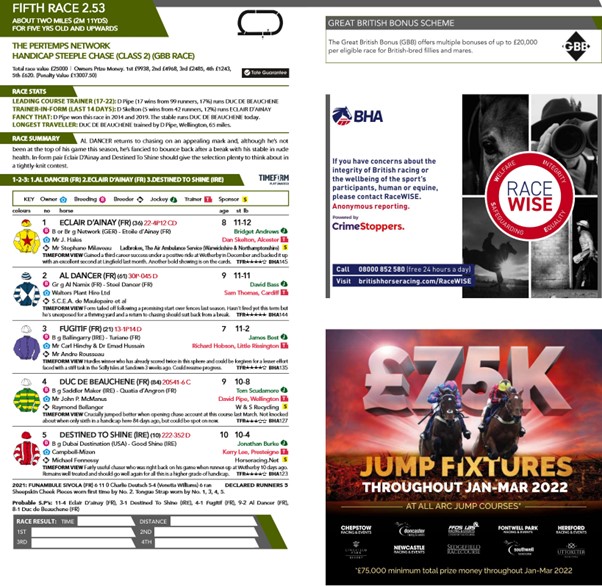
Racecard

You may struggle to zoom into our example of an actual racecard page so let’s set a fictional race so we can analyse what each section refers to:

  • 3:30 Southwell (AW)
  • The 888Sport Bet On Cheltenham Handicap (Class 4) (3yo+ 0-70)
  • Winner: £5,000
  • Runners: 10
  • Distance: 1m
  • Going: Standard
  • Channel: Sky Sports Racing

Understanding A Racecard

  • 3.30 - This is the time that the race should officially start at. Quite often there will be some slight delays because at the end of the day, horses can be unpredictable animals.
  • Southwell (AW) - This is the name of the racecourse the racing is taking place at. The (AW) in brackets informs us that we are racing on this occasion is on an all-weather track.
  • The 888Sport Bet On Cheltenham Handicap - the title of the race usually incorporates the sponsor’s name or makes reference to who is putting up the prize money. The 888Sport brand continually sponsors a variety of UK horse races throughout the season. 

If the race is a handicap, the word handicap is included in the race’s title itself or in brackets somewhere in the title. During the National Hunt Season, this race title header informs us whether the race is a chase, hurdle or national hunt flat race (NHF).

  • Class 4 - This refers to the stature of the race in terms of the quality of its participants. On the Flat the range extents from the top class (Group 1) to the lowest division – class 7. Over the jumps it ranges from Grade 1 (the top) to class 6.
  • (3yo+ 0-70) - This section tells us which horses are eligible to run in the contest. This example race is open to all horses aged three years old and over and which are rated up to 70. A horse rated over this mark cannot enter.
  • Winner: £5,000 - This is self explanatory really. This is the amount of prize money handed to the winning owners. The better quality races invariably carry more prize money as a rule of thumb.
  • Runners - This is the number of runners declared to run in the race. This figure is very important to punters when they are considering how many places will be on offer if they wish to place an each-way bet. Essentially the rules are: 1-4 runners (win only), 5-7 runners (e/w 1,2), 8-15 runners (e/w 1,2,3), 16 runners+ handicaps (1,2,3,4). Bookmakers quite often offer extra places on certain races so it is best to check their each-way conditions beforehand for your selected race.
  • Distance - This is the distance over which the race will be run. It is generally set out in miles, furlongs and yards.
  • Going - This refers to the type of ground conditions the horses will be running on.

AW racing will be either standard (St) or standard/slow (St/Slw).

Turf Racing will be either Heavy (Hvy); Soft (Sft); Good to Soft (GS); Y (Yielding, *IRE only), Good (G); Good To Firm (GF); Firm (Fm).

  • Channel - This is where you can expect to watch the race live. As of 2022, the television channels that show live horse racing are: UK: Racing TV, Sky Sports Racing & ITV. IRELAND: Racing TV, RTE & ITV Racing Tips

As well as these channels, most bookmakers’ websites allow access to the live pictures either for free or a minimum betting stake (often 50p).

What Other Information Is On The Racecard? 

So far we have only picked up on the basics of the racecard but of course there is so much more information contained in them.

Jockey Colours

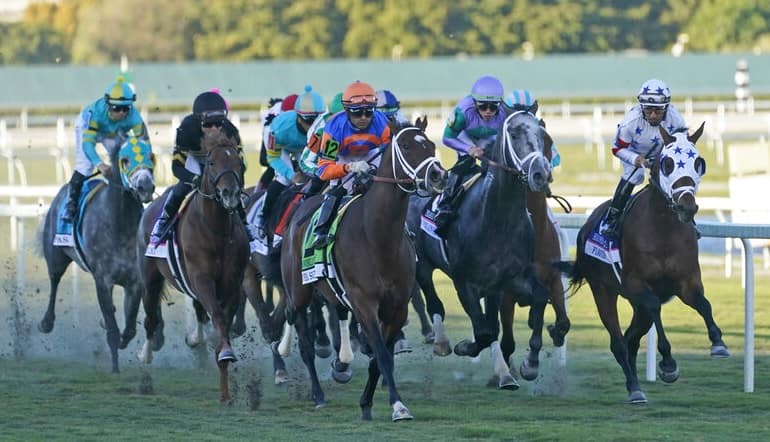
The first thing people notice is the colourful array of shirts the jockeys wear. These are also known as silks and are designed by the horse's owners.

Sometimes an owner may have two or more jockeys in the same race wearing the same colours, so the caps vary in colour in order for the spectators to differentiate between the horses.

Draw

Next to the horse's number, you will see another number in brackets. This is the number of the stall the horse will race from in a Flat race. There are no stalls in NH races.

The draw is an important factor in selecting a horse. Short races with large fields and track biases for particular sides of a racecourse are both impacted by the draw.

Headgear

As well as the bridle, horses can sometimes have other accessories added to their body to help with their concentration. In a racecard, you will sometimes see these main ones listed:

h – hood, b - blinkers (if being worn for a first or second time a 1 or 2 will be beside the letter), p - (sheepskin) cheekpieces, t - tongue-tie, v – visor, e - eye hood, Ht - hood and tongue-tie, e/c – eyecover, e/s – eyeshield.

Betting

You will find the predicted betting odds underneath the runners at the bottom of the page.

Form

This is probably the most important element of any racecard.

A horse’s recent form is usually displayed near to his/her name on the card. This figures and letters show how the horse has performed in their most recent outings.

Form figures are read from left to right, with the number on the far right indicating a horse’s most recent run.

The numbers represent the positions the horse finished in. Abbreviations (i.e the letters) are used alongside the numbers. P = Pulled Up, F = Fell, UR = Unseated Rider, BD = Brought down, R = Refused, are the main ones, but you will sometimes see S = slipped, O = horse ran out, D = disqualified, V = void.

A hyphen indicates a new season, while a forward slash indicates two seasons have passed.

If you are ever unsure about form figures, just ask somebody, especially if you are in attendance at a race meeting. People are always happy to help.


*Credit for all of the photos in this article belongs to AP Photo*


FIRST PUBLISHED: 10th March 2022

March 11, 2022

By Steve Mullington

Steve Mullington
  • ">
  • Body

    Steven is a sports and horse racing enthusiast and is a member of the Horseracing Writers and Photographers Association (HWPA) in the United Kingdom.

    He is a regular visitor to Paris Longchamp for the Prix de l'Arc de Triomphe and a lifelong fan of the Aintree Grand National, a subject he writes about 52 weeks of the year. Last year he reached the impressive milestone of attending the last 30 renewals of the Grand National.

    Steven graduated from the University Of Lancaster in 1996 with a B.A (Hons) in Urban Policy & Race Relations (major) with Contemporary Religions & Belief Systems (minor) and still wonders if any of these help him find the winners?

    He writes for a number of websites and online publications and you can sometimes hear him at the weekend discussing racing on a number of local radio stations. 

    Steve Mullington
    factcheck
    Off
    hidemainimage
    show
    Hide sidebar
    show
    Fullwidth Page
    Off
    News Article
    Off
    • Chief Mouse was the first horse in the UK to win in cheekpieces in 1998
    • The Jockey Club originally said the new headgear was a “fad”
    • Mighty Thunder won the 2021 Scottish National wearing cheekpieces

    Why Use Headgear In Racing?

    Some trainers have found that if they apply headgear to their racehorse it helps them maintain focus.

    Horses often get spooked by something in their peripheral vision and some are affected by the slightest of movements on a regular basis. When this happens the trainer usually reaches for some sort of headgear.

    What Are Cheekpieces?

    One form of headgear that horses are allowed to wear for racing in the UK and Ireland are cheekpieces (also known as French blinkers).

    Bet Calculator

    They consist of two soft lengths of sheepskin that are attached to the bridle and run down either side of the horses head.

    The job of the cheekpieces is to partially obscure the vision of the horse, with the idea being it cannot see what is immediately behind in its peripheral vision.

    In theory the horse should now concentrate on the course in front and be geared up to clear the jumps and ditches if they are a National Hunt horse. It helps to keep their minds settled during a race.

    Benefits Of Cheekpieces

    Sheepskin cheekpieces are renowned for helping a horse concentrate and avoid distractions.

    Grand National-winning trainer Lucinda Russell uses extra large French blinkers on her runners that have concentration problems. Speaking previously about Caesars Palace, who was quite a handful on a racecourse:

    “He’s a very cunning horse, and if you put normal blinkers on him, he’ll sulk, but the cheekpieces make him think that he hasn’t got anything on and are less restrictive than blinkers.

    "The effect is that when a horse suddenly comes up behind him and into his line of vision, he’s surprised and surges forward."

    Evolution Of Cheekpieces

    Once considered a “fad” by the Jockey Club, cheekpieces have become commonplace in British horse racing. Back in 2002, when Storming Home wore them in the 2002 Champion Stakes, a Timeform essay wrote of them:

    “The horse was sporting a set of outlandish white sideburns. One might have thought that sideburns of such proportions had gone out of fashion with Palmerston, Gladstone or Tory MP’s of the Thatcher era such as Dr Rhodes Boyson, but they are the latest word in what horses can be seen in when out and about on Britain’s racecourses.

    "More usually these pieces of equine headgear are described as sheepskin cheekpieces. Apparently, they perform a similar function to blinkers or a visor, but allow more vision.

    Speaking after the Champion Stakes, Barry Hills, trainer of winner Storming Home, explained that “the cheekpieces have made him concentrate and made him an easier horse to ride’ and winning jockey Michael Hills said that “the cheekpieces have made a big difference – he just travels so much better”.

    Storming Home was the NAP of the day in many newspapers even though he was wearing cheekpieces.

    Declaring Cheekpieces

    Cheekpieces must, like other forms of headgear, such as blinkers, hoods and visors, be declared overnight. It is important that horse racing punters are privy to this information before they place a bet.

    A horse wearing cheek pieces is denoted by a letter ‘p’ after the horse’s name in the trade papers and in the race cards.

    For those of you that go racing in France, sheepskin cheekpieces are marked on the official programme after the name of a horse by the symbol “X”.

    Discovering whether your fancied horse is wearing cheekpieces may enhance your Cheltenham Festival betting strategies in the long run?

    Up until 2002, only on-course punters in the UK were aware when a horse was equipped with sheepskin cheek pieces.

    Many people thought this was grossly unfair and representations were made to make this information freely available the night before the race.

    The Jockey Club were very lukewarm on the whole declaration idea in the early days. John Maxse, their public relations director at the time was quoted as saying:

    "The decision whether to require trainers to declare sheepskin cheek pieces has put us in something of a quandary and we are not totally committed to its introduction.

    "It has been put on the backburner as we would have to justify the additional computer cost (believed to be around £8,000) for what may be a little bit of a fad."

    Sheepskin cheek pieces were first employed on a British racecourse, by the trainer Frank Jordan on Chief Mouse at Bangor in September, 1998.

    Described by his trainer as "an old monkey", Chief Mouse (5/1 in the betting) won by a head – his first success for 18 months!

    Recalling that day Jordan said: "When we tried Chief Mouse in ordinary blinkers he didn't do a tap, but he worked like a dream in the cheek pieces.

    When his owner walked into the paddock he turned to me saying: 'What the hell are those things? Take them off'.

    Pam Sly, who trains near Peterborough, put them on her chaser I've No Say and he won twice after being fitted with them. Mrs Sly commented: "They are less severe than blinkers and are useful on a horse who has lost his edge. I can see no problem with declaring them."

    Midlands-based trainer Ian Williams was very dubious about cheekpieces at the time. "I used them once when we forgot to declare blinkers, but I don't think they are as effective and I never saw them in France when I worked for François Doumen," he said.

    “Some may say cheek pieces are pulling the wool over punters' eyes, but declaring them seems unlikely to make sorting out the sheep from the goats any easier.”

    The application of cheekpieces by trainers down the years has considerably helped many punters with their horse racing online bets.

    Famous Horses Who Won Wearing Cheekpieces

    • Jan 2022 - Paddy Power Cotswold Chase (Grade 2) Chantry House (Nico De Boinville)
    • Nov 2021 - Badger Beer Handicap Chase (Listed) Rocco (Jordan Nailor)
    • Sept 2021 - Irish St. Leger (Group 1) Sonnyboyliston (Ben Coen)
    • Apr 2021 - Punchestown Gold Cup Chase (Grade 1) Clan Des Obeaux (Sam Twiston-Davies)
    • Apr 2021 - Scottish Grand National (Grade 3) Mighty Thunder (Tom Scudamore)
    • Oct 2020 - Champion Stakes (Group 1) Addeybb (Tom Marquand)
    • Jul 2020 - Derby (Group 1) Serpentine (EJ McNamara)
    • Mar 2019 - Pertemps Final (Grade 3) Sire Du Berlais (Barry Geraghty tips)

    *Credit for all of the photos in this article belongs to AP Photo*


    FIRST PUBLISHED: 10th March 2022

    March 11, 2022

    By Steve Mullington

    Steve Mullington
  • ">
  • Body

    Steven is a sports and horse racing enthusiast and is a member of the Horseracing Writers and Photographers Association (HWPA) in the United Kingdom.

    He is a regular visitor to Paris Longchamp for the Prix de l'Arc de Triomphe and a lifelong fan of the Aintree Grand National, a subject he writes about 52 weeks of the year. Last year he reached the impressive milestone of attending the last 30 renewals of the Grand National.

    Steven graduated from the University Of Lancaster in 1996 with a B.A (Hons) in Urban Policy & Race Relations (major) with Contemporary Religions & Belief Systems (minor) and still wonders if any of these help him find the winners?

    He writes for a number of websites and online publications and you can sometimes hear him at the weekend discussing racing on a number of local radio stations. 

    Steve Mullington
    factcheck
    Off
    hidemainimage
    show
    Hide sidebar
    show
    Fullwidth Page
    Off
    News Article
    Off

    Barry Geraghty and John Francome: The Road to Cheltenham Part 1

    Barry Geraghty and John Francome are on a road trip down memory lane, as they look forward to the Cheltenham Festival 2022.

    The legendary National Hunt jockeys start their journey in the Valley of the Racehorse, Lambourn, and wind their way through Oxfordshire and the Cotswolds before reaching the mecca: Cheltenham.

    They'll be plenty of laughs along the way as the pair reminisce about their Cheltenham Festival wins and the stories behind them, as well as giving their picks for this year's big races, including the Champion Hurdle, Queen Mother Champion Chase, Stayers' Hurdle and Cheltenham Gold Cup.

    In part one of a four-part series, Geraghty, who rode 43 Cheltenham Festival winners, picks up Francome from his Lambourn home, and they soon wind past the HQ of Barry's former boss, Nicky Henderson, who is preparing the favourite for the Supreme Novices' Hurdle, Constitution Hill, and to whom Geraghty bought and sold to Henderson as a foal.

    As the duo motor through the Oxfordshire hills, talk soon gets on to this year's Arkle Chase and then the feature race of day one, the Champion Hurdle.

    With unbeaten mare Honeysuckle bidding to defend to her crown for trainer Henry de Bromhead and jockey Rachael Blackmore, Geraghty and Francome are split as to whether she can hold off the challenge of the Willie Mullins-trained Appreciate It.

    Geraghty, who won the Champion Hurdle four times on the likes of Jezki and Epatante, and Francombe, who triumphed on Sea Pigeon, can't split the pair.

    Scroll down for part two of Barry and John's Road to Cheltenham, which sees them look forward to day two of the Cheltenham Festival, featuring the Queen Mother Champion Chase.

    Barry Geraghty and John Francome: The Road to Cheltenham Part 2

    Barry Geraghty and John Francome continue their Road to Cheltenham as they reminisce about the Queen Mother Champion Chase and look forward to this year's renewal.

    The legendary National Hunt jockeys recall Geraghty's fabulous five wins in the race, twice on Moscow Flyer and one victory each on Big Zeb, Finian's Rainbow and Spinter Sacre, as they wind through the Oxfordshire countryside on their journey to Prestbury Park.

    Geraghty talks of his affection for the race and his five winners, and struggles to split Moscow Flyer and Sprinter Sacre in his hall of fame.

    This year, the likes of Nicky Henderson's Shishkin and the Willie Mullins-trained pair Chacun Pour Soi and Energumene are bidding for a crown which eluded Francome during his illustrious career.

    The pair also preview the Ballymore Novices' Hurdle, in which the Mullins horse Sir Gerhard is strongly fancied, while in the Brown Advisory Novices' Chase, Bravemansgame and Galopin Des Champs are vying for favouritism.

    Make sure you look out for part three of Barry and John's Road to Cheltenham, which sees them look forward to day three of the Cheltenham Festival, featuring the Stayers' Hurdle.

    Barry Geraghty and John Francome: The Road to Cheltenham Part 3

    Barry Geraghty and John Francome are edging closer to Cheltenham on their road trip to Prestbury Park.

    In part three of the Road to Cheltenham, Francome and Geraghty are focusing on day three of the Festival, which features the Stayers' Hurdle and Ryanair Chase.

    Geraghty won the Stayers' Hurdle on Iris's Gift for trainer Jonjo O'Neill, while Francome triumphed in the race on Derring Rose.

    This year, 2019 winner Paisley Park is bidding to regain his crown but it's a wide-open content, with the likes of Flooring Porter, the Willie Mullins-trained Klassical Dream, Thyme Hill and Champ all vying for the favourite's tag.

    Geraghty, who won on Champ in 2020 in what is widely considered to be one of the great Festival rides, is unsure whether his former partner can get back in the winners' enclosure again this year and is leaning towards Klassical Dream.

    In the Ryanair, Allaho is considered to be one of the bankers of the meeting, but both Francome and Geraghty think Eldorado Allen has a strong each-way chance.

    And in the Turner Novices' Chase both are backing Galopin Des Champs to get the better of Bob Ollinger in what some think could be the race of the meeting.

    Scroll down for part four of Barry and John's Road to Cheltenham, which sees them look forward to day four of the Cheltenham Festival, featuring the Cheltenham Gold Cup.

    Barry Geraghty and John Francome: The Road to Cheltenham Part 4

    It's the final part of Barry Geraghty and John Francome's Road to Cheltenham, as they reach Cheltenham town centre and make the final climb atop the iconic Cleeve Hill.

    The Cheltenham Gold Cup is the feature race on the Festival's final day, and both Geraghty and Francome have triumphed in racing's premier steeplechase.

    Francome took glory aboard Midnight Court in 1978, while Geraghty crossed the winning line in first on both Kicking King and Bobs Worth.

    This year, the likes of A Plus Tard, Galvin and defending champion Minella Indo are going for glory, with strong challenges expected from Protektorat, former winner Al Boum Photo and Tornado Flyer.

    Geraghty believes Henry de Bromhead's Minella Indo will take some stopping, despite his defeat in the King George at Kempton, while Francome says stablemate A Plus Tard, second last year, can reverse the placings this year.

    The pair also make their selections in the Albert Bartlett Novices' Hurdle and the Triumph Hurdle.

    Vauban is favourite to give Wille Mullins yet another Festival winner in the Triumph, while a wide-open Albert Bartlett could go the way of the Gordon Elliott-trained Ginto.


    March 13, 2022

    By Barry Geraghty

    Barry Geraghty Tipster
    Body

    With 43 winners at the Cheltenham Festival, Barry Geraghty is the second most successful jockey in the meeting’s illustrious history.

    Career highlights include five Queen Mother Champion Chase victories, two Cheltenham Gold Cup triumphs and victory aboard Monty’s Pass in the 2003 Grand National.

    Barry has partnered with 888sport for the 2021/22 jumps season, providing his expert insight and horse racing analysis on the biggest races of the week.

    Come back every Friday to find out the latest instalment of Barry Geraghty tips for upcoming fixtures across the United Kingdom & Ireland.

    Barry Geraghty
    factcheck
    Off
    hidemainimage
    show
    Hide sidebar
    show
    Fullwidth Page
    Off
    News Article
    Off
    • One of the greatest jockeys to ride around Prestbury Park, Barry Geraghty chats to 888sport about the best way to ride at Cheltenham

    • Geraghty talks about his Cheltenham Festival highs and lows while also offering his unique insight into the moments races are won and lost at the meeting

    • Follow Barry's best bets and tips across all four days at the 2022 Cheltenham Festival


    Barry Geraghty rode 43 Cheltenham Festival winners, so knows almost better than anyone the ins and outs of riding what is probably the most unique track in National Hunt horse racing.


    With the Cheltenham Festival 2022 just a week away, 888sport horse racing ambassador Geraghty, who has won all of the Cheltenham Gold Cup, Champion Hurdle, Queen Mother Champion Chase and Stayers' Hurdle at least once, walks the course and explains just what a challenge it presents for both horse and rider.

    What are the differences between the Old and New courses? Which are the fences that catch out inexperienced novices? How significant are the undulations? Did Ruby Walsh or AP McCoy ride Cheltenham better?

    Geraghty answers these questions and more as he recalls the moment the great Moscow Flyer came down at one of the open ditches in the 2004 Queen Mother Champion Chase, while he describes how the energy-sapping uphill finish provides as big a tactical test as it does an examination of stamina, which played into his hands on Finian's Rainbow in the 2012 renewal of the race.

    And what of his miraculous ride on Champ in the 2019 RSA Novices' Chase?

    The Nicky Henderson-trained gelding come from an impossible position at the third last fence to snatch glory in the dying strides from the likes of Minella Indo, trained by Henry de Bromhead, and the Willie Mullins-trained Allaho, in what is widely considered to be one of the great Cheltenham Festival rides.


    March 11, 2022

    By Barry Geraghty

    Barry Geraghty Tipster
    Body

    With 43 winners at the Cheltenham Festival, Barry Geraghty is the second most successful jockey in the meeting’s illustrious history.

    Career highlights include five Queen Mother Champion Chase victories, two Cheltenham Gold Cup triumphs and victory aboard Monty’s Pass in the 2003 Grand National.

    Barry has partnered with 888sport for the 2021/22 jumps season, providing his expert insight and horse racing analysis on the biggest races of the week.

    Come back every Friday to find out the latest instalment of Barry Geraghty tips for upcoming fixtures across the United Kingdom & Ireland.

    Barry Geraghty
    factcheck
    Off
    hidemainimage
    show
    Hide sidebar
    show
    Fullwidth Page
    Off
    News Article
    Off
    • There are several types of bridle that can be fitted onto a racehorse
    • Some bridles are “bitless”
    • Paddock watching a horse in its bridle can aid your punting

    What Is A Bridle And How Does It Work?

    Racehorses are very powerful animals and in order to be able to ride and control them some sort of contraption needs to be applied.

    This item is universally known as the bridle. The whole relationship between a horse and its rider rests in the correct use of the bridle.

    The bridle is a piece of headgear that the racehorse wears in order for the jockey to be able to steer and control it.

    The bridle generally consists of a bit that runs between the horse’s teeth attached to head straps, while the long reins come back down the neck and into the hands of the jockey.

    If horses were not fitted with a bridle then they would be unsteerable and their riders would be plonked on the floor after a few strides.

    Bridle Types

    Naturally bridles come in all sorts of designs and types and some work for particular horses better than others. The following bridal types can typically be found on racehorses today:

    • Anatomic Bridle

    Anatomical bridles are designed with the horse’s anatomy in mind. They allow the horse to be more comfortable and move freely.

    This type of bridle is designed and cut to be a specific shape to help prevent pressure on a horse’s facial nerves.

    • Micklem Bridle

    The Micklem bridle is designed from the inside out and from the shape of the skull itself.

    This is to avoid any pressure on the five areas which consistently cause discomfort with traditional headwear.

    • Double Bridle

    The double bridle (also known as the Weymouth Bridle) consists of two bits: the bridoon (snaffle bit) and the curb.

    The double bridle can have a very sharp effect on the horse's mouth due to the increased leverage it offers is therefore only suitable for experienced riders.

    • Schockemohle Bridle

    Schockemohle are designed with a specifically shaped headpiece and nose band to release pressure from the horses head, nose and neck, making sure that the horse has the maximum comfort through extra padding.

    • Bitless Bridle

    Bitless bridles have been observed to solve a number of issues, from head shaking and bridle lameness to napping, rearing and anxiety.

    Ridden behaviours like head nodding and excessive salivation also lead to riders and trainers to explore bitless options for their horse.

    • Snaffle Bridle

    The snaffle is the most commonly used bridle because of its versatility and functionality. The snaffle bridle can be used for most horse disciplines including jumping, dressage, and trail riding.

    It can be used with a snaffle bit or with a Pelham or curb bit. A racing term you sometimes hear which is derived from this bridle name is “the horse was on the snaff”.

    On The Bridle vs Off The Bridle

    These are very familiar terms in the sport of horse racing but what do they actually mean in practice?

    The term “on the bridle” is used when a horse has got used to the bit being between its teeth and the reins flow back naturally to the jockey.

    Sometimes horses don’t take to the bridle and they become frustrated and fractious in the paddock. Quite often you will see a horse fighting against the bit with its tongue in the parade ring.

    Generally when the jockey climbs on board they put the horse at ease and familiarise it with the bridle. In most cases the horse will settle and will be ready to race.

    Conversely, “off the bridle” is a phrase used when the horse isn’t travelling well during a race. Quite often later down the line, such horses are always equipped with cheekpieces.

    If a racing pundit or commentator ever says of a horse ‘it won on the bridle’ it generally means it won with the minimum of fuss and did not need to be ridden vigorously.

    Do Bridles Impact Betting On Horse Racing?

    Horse racing is fundamentally a betting sport and punters can quite often gain an edge in their betting if they can identify which horses are on or off the bridle.

    As well as identifying which horses are comfortable in the paddock with their bridle, you can also work out which ones are at ease with their equipment whilst heading down to the start.

    Jumps races are much longer than flat races so a horse is more likely to come off the bridle in the NH sphere, In short sprint races horses don’t generally come off the bridle because the races are over quite quickly.

    When a horse reaches the limit of its stamina reserves it will come off the bridle and invariably will struggle to hold its place.

    Being able to identify when a horse has come off the bridle is an important tool and skill for successful horse racing punters, especially those that play the in-running markets with their horse racing online bets.

    A trained eye can give you an increased advantage over your fellow bettors.

    You must remember that for 90% of the race the jockey's job is to slow the horse down and save his energy for the concluding stages of the race.

    A horse that is running 'on the bridle' is still being held back from going full speed by the jockey pulling him/her back with his the reins.

    Horse Racing Bridle


    A horse that is running 'off the bridle' is one where the jockey has had to let go of his tight grip and allow the horse to run faster to maintain its momentum.

    The jockey lets some slack go out of his reins because he is struggling to keep up with the other horses that are still around him and are still on the bridle. His mount will probably now struggle to maintain those exertions for a prolonged period of time.

    Being ridden 'off the bridle' is generally an ominous sign for a punter as the horse is highly likely to be overtaken and swamped by the chasing pack.

    At the end of any given race most horses will be 'off the bridle' because the battle to the line saps up all their reserves of energy. Of course there are some exceptions... 

    Some horses are simply lazy travellers and need to be cajoled along by the jockey for most of the race.

    Many horse racing commentators will incorrectly describe these types as being 'off the bridle' when in fact it is just the way they always run and they tend not to find much extra when let off the bridle.

    Sometimes horses win very easily and visually never come 'off the bridle''. The commentators and pundits will often make a big deal about this because it leads to the notion that they could have won by a lot further if the jockey let them off the bridle.

    Often you will hear associated descriptions such as “he won hard held” and “the jockey had a double handful'” both implying that the horse won even though the jockey still had hold of a tight rein.

    A high percentage of horses that score in this manner are quite often the NAP of the day in the national newspaper racing pages.


    *Credit for all of the photos in this article belongs to AP Photo*


    FIRST PUBLISHED: 9th March 2022

    March 11, 2022

    By Steve Mullington

    Steve Mullington
  • ">
  • Body

    Steven is a sports and horse racing enthusiast and is a member of the Horseracing Writers and Photographers Association (HWPA) in the United Kingdom.

    He is a regular visitor to Paris Longchamp for the Prix de l'Arc de Triomphe and a lifelong fan of the Aintree Grand National, a subject he writes about 52 weeks of the year. Last year he reached the impressive milestone of attending the last 30 renewals of the Grand National.

    Steven graduated from the University Of Lancaster in 1996 with a B.A (Hons) in Urban Policy & Race Relations (major) with Contemporary Religions & Belief Systems (minor) and still wonders if any of these help him find the winners?

    He writes for a number of websites and online publications and you can sometimes hear him at the weekend discussing racing on a number of local radio stations. 

    Steve Mullington
    factcheck
    Off
    hidemainimage
    show
    Hide sidebar
    show
    Fullwidth Page
    Off
    News Article
    Off
    • Kylian Mbappe, Timo Werner and Alphonso Davies feature among the fastest footballers in the world

    • Davies is one of three Bayern Munich stars in this fastest football player list

    • How important is speed in the modern game?


    The fastest football players in the world are always a football betting factor.

    While pace isn’t a necessity for elite footballers, it can change matches. Being able to run in behind or recover in defence is invaluable.

    Fastest Footballers In The World (2022):

    The quickest footballers in the world are not necessarily in the Golden Boot running – some are creators, and many operate from full-back or wing-back roles.

    Here are 10 of the fastest football players on the planet, led off by Paris Saint-Germain superstar and World Cup winner Kylian Mbappe.

    Kylian Mbappe

    A sports betting favourite to win the Ballon d’Or, Kylian Mbappe is an unstoppable force. Since signing for PSG, Mbappe has scored 104 goals in 145 matches. His 16 goals in 39 appearances for France is almost as impressive.

    While his pace petrifies defenders and makes managers rethink their tactics, Mbappe has grown as an all-round footballer. He’s clinical in front of goal and his close control is sublime.

    Players as mind-bendingly fast as Mbappe can sometimes see their speed overshadow their talent – the World Cup winner is arguably the most valuable footballer in the world.

    Kyle Walker

    His future with England might be uncertain, and Joao Cancelo has displaced him at Manchester City, but Kyle Walker is still one of the quickest players around.

    Walker turns 31 in May. He isn’t as effective going forward as Trent Alexander-Arnold or as solid defensively as Aaron Wan-Bissaka, though his importance on one of the world’s strongest teams cannot be overstated.

    https://www.888sport.com/blog/football-prediction

    Walker has stuck at City through some periods of defensive chaos – his pace has been invaluable to save City from countless counters.

    Inaki Williams

    Signed to Athletic Bilbao’s youth setup at 18, Inaki Williams has flourished at the Basque club. Interest from the Premier League’s biggest clubs never resulted in a move – Williams has made over 250 appearances for Athletic’s first team.

    A favourite of FIFA Ultimate Team players, Williams is equally comfortable on the right or down the middle.

    Standing at over 6’0 tall, he’s got the upper body strength to play with his back to goal, though his extreme pace means he’s at his most effective with space to run in behind.

    Adama Traore

    Adama Traore was seldom considered one of the best young footballers during his time at Barcelona. Spells with Middlesbrough and Aston Villa followed for Traore, who has finally settled at Wolves and carved out a role in Nuno Espirito Santo’s squad.

    Sometimes deployed as a right wing-back, sometimes up front, sometimes on the right of a front three, Adama is a must-watch talent. He fearlessly dribbles at opponents. Defenders are known to just bounce off him.

    Unique as an athlete and a player, interest from other clubs has been inevitable – will a Champions League club pay big bucks for Traore?

    Leroy Sane

    Not many players have chosen to leave Manchester City in the Pep Guardiola era. Leroy Sane is the exception – the German international returned home to sign with Bayern Munich, adding to the European champions’ embarrassment of attacking riches.

    Sane started his career at Schalke before earning his big move to Manchester. He flourished, and his wing partnership with Raheem Sterling became a fearsome prospect for any defence.

    The pace is a big part of his game, but Sane also possesses immense strength to hold off defenders and would-be tacklers.

    Sadio Mane

    Liverpool were destined to have an entrant on this list. Sadio Mane or Mohamed Salah could stake a claim as the fastest player on their team – both have humiliated many a defence with their quick acceleration.

    Mane uses his pace effectively in and out of possession. He frequently robs opponents, appearing at their feet quicker than they expected. He wins loose balls, and makes perfectly timed runs in behind the defence.

    It’s not been his best start to the season, but Mane is still in the top five wingers in the world.

    Timo Werner

    It hasn’t been the start Timo Werner will have hoped for when he agreed to sign for Chelsea.

    The German international was an analytics darling during his final season with RB Leipzig – the strong underlying numbers have not resulted in an impressive return during his early months with the Blues.

    Werner might not be the most clinical, but there are few defenders who can keep up with him. Premier League centre-backs have no chance when Chelsea are on the break.

    Alphonso Davies

    Starring for the most successful football club in Germany, Alphonso Davies’ story is a fascinating one. Davies arrived as a raw left winger, but he has quickly ascended to become one of the best left-sided defenders around.

    Playing on a Bayern team as stacked with talent as any squad in recent memory, Davies is a key component. His speed stretches defences and the quality of his delivery from left-back is as good as anyone’s.

    Achraf Hakimi

    A versatile full-back who can play on the left or right, Achraf Hakimi is one of the fastest footballers on the planet.

    His pace, like Alphonso Davies, makes him an immense threat on the overlap and allows him to recover even against mobile wingers.

    Hakimi signed with Inter in the offseason after an impressive loan stint with Borussia Dortmund. At 22 years of age, the Moroccan has several seasons of elite production to come. He’s already proven to be a masterful signing for Antonio Conte’s side.

    Douglas Costa

    Despite celebrating his 30th birthday last year, Douglas Costa is still electric. The Brazilian fell out of favour at Juventus and has returned to Bayern Munich on loan where he has joined an immense group of talent on the wings.

    Costa’s career has been split between the two superclubs since leaving Shakhtar Donetsk back in 2015. He has collected five league titles across Munich and Turin, often dazzling with his quick footwork and blistering pace.

    Never the star of his team, his impact has often been undervalued despite his eye-catching pace off the left wing.


    *Credit for the main photo belongs to David Vincent / AP Photo*

    August 2, 2022
    Body

    Sam is a sports tipster, specialising in the Premier League and Champions League.

    He covers most sports, including cricket and Formula One. Sam particularly enjoys those on the other side of the Atlantic Ocean – notably MLB and NBA.

    Watching, writing and talking about sports betting takes up most of his time, whether that is for a day out at T20 Finals Day or a long night of basketball.

    Having been writing for several years, Sam has been working with 888Sport since 2016, contributing multiple articles per week to the blog.

    Sam Cox
    factcheck
    Off
    hidemainimage
    show
    Hide sidebar
    show
    Fullwidth Page
    Off
    News Article
    Off

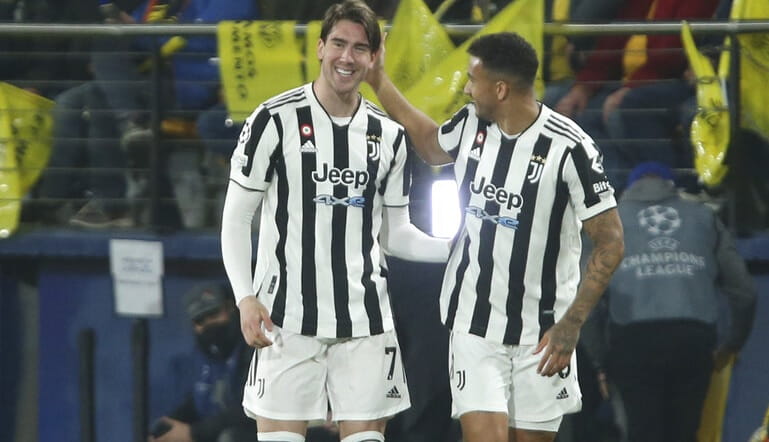
    The Dusan Vlahovic deal was the most secret of the entire January transfer window. A complicated, strategic negotiation, full of issues for many clubs and which has become a brilliant solution for Juventus.

    But this story Dusan Vlahovic starts from afar: his contract with Fiorentina was expiring in June 2023, the club begins talks to sign a longer agreement but the green light does not arrive from the player during last summer.

    Fabrizio Romano articles

    That's why Fiorentina listen to the proposals of the other clubs: Tottenham are interested but the best offer is from Atletico Madrid, putting on the table an official bid for € 50 million guaranteed plus € 10 million add-ons and a percentage on the future resale of the Serbian striker.

    Dusan doesn't even want to listen, he doesn't answer and doesn't accept; so Fiorentina do not even begin to negotiate between clubs.

    Last September, Fiorentina president Rocco Commisso tried to change the situation: the club offered Dusan Vlahovic a five-year contract worth over € 5 million net per season.

    It would officially be the best contract in Fiorentina's history, even better so than legends like Gabriel Batistuta, Rui Costa or Roberto Baggio had: no one has earned as much as Vlahovic would earn with this potential deal.

    But Dusan and his agents refuse, they have no intention of talking about it. When in November it appears that a deal is close for € 5 million a year and € 2 million to the agents, the demand suddenly rises to € 8 million to the player and € 6 million to the agents.

    In addition, a 10% future resale has been asked too by the agents. Fiorentina refuse, the break is total and since the beginning of December, Arsenal begin to try with great ambition a negotiation to buy Vlahovic in January: the club's board has an excellent relationship with Fiorentina, the deal for Lucas Torreira in the summer has built a strong very good dialogue between the two clubs.

    The problem for Arsenal is always the same: Dusan Vlahovic's agents do not even answer the calls and proposals from the Gunners, just as happened in the past with other clubs.

    There is no intention of negotiating, a silence on the Vlahovic side that will also last during the first weeks of January: Arsenal promise Fiorentina €65 million more add-ons to have Dusan immediately, the two clubs practically agree verbally but they have to wait for the player and his decisions.

    Zero answers, until the Gunners pull back from the negotiation as they did for Manuel Locatelli in the summer: you cannot chase a player forever, Vlahovic and his silence nullify the hopes of Arsenal and also a potential attempt by other clubs such as Tottenham, more oriented on the summer than on a transfer for January.

    Fiorentina managers are starting to get very nervous because there is the fear of losing Dusan as a free agent next January 2023, it would be a disaster for the club's balance.

    And it was precisely in this "fear" that Juventus entered the race: for months Juventus had already obtained information on Vlahovic and the costs of a potential negotiation.

    But when the Serbian striker finally turned down Arsenal and other solutions in the Premier League, Juventus contacted Fiorentina for an official offer that the board had been preparing in great secrecy since the beginning of January.

    This is why it was a much faster deal than expected: Juventus received guarantees on the probable sale of Dejan Kulusevski, so president Andrea Agnelli gave the green light to an initial offer of € 65 million.

    The negotiation is rapid, because Fiorentina asks for € 80 million and Juventus conclude the agreement for € 75 million guaranteed plus € 5 million in add ons. In one night, Juventus and Fiorentina reach a full agreement for Dusan.

    Vlahovic


    And there is a man behind this deal: Massimiliano Allegri, Juventus manager, had been insisting for weeks on making an attempt for Vlahovic.

    He sees Vlahovic as the forward of the present and the future, a statement of return to the top level for the club. That's why Juventus wasted no time.

    The direct negotiation with Vlahovic is not complicated for the Bianconeri: while Dusan did not intend to speak to Arsenal or other clubs, the Serbian striker and his agents give immediate availability to Juventus.

    Those who are very close to Vlahovic say that ever since he started playing football as a child, he dreamed of Juve as the ideal club for such an important step.

    For this he immediately accepted a contract of € 7 million net per season for five years, until 2026. The negotiation continued for 24 hours on the commissions to the agents who will receive € 10.6 million as part of the deal.

    The signing of the contract completed an operation that for Juventus was like a spy story: the hope in the rejection of the Premier League, then jumping in the race with an offer at the right time. This is the crazy story of Vlahovic, the new Juventus star.


    *Credit for all of the photos in this article belongs to AP Photo*


    FIRST PUBLISHED: 23rd February 2022

    February 23, 2022
    Body

    Fabrizio Romano is an Italian sports journalist. He was born in 1993, he lives in Milan and has over 30 million followers in total on the major social networks.


    He collaborates with 888sport, CBS Sports, Sky Sport, The Guardian and has been a transfer market expert since 2011. He will take care of a column dedicated to some "Behind the Scenes" of transfers.

    Fabrizio Romano
    factcheck
    Off
    hidemainimage
    show
    Hide sidebar
    hide
    Fullwidth Page
    Off
    News Article
    Off